Case study of the St. Stephen Walbrook church
Context
Sir Christopher Wren was an architect from 17th century London. He was responsible for rebuilding several parish churches after the Great Fire of London in 1666.
Although acoustics were an underdeveloped field at the time, Wren left some recommendations for so-called auditorium churches in his writings, largely based on his own experiences. His main motivation was to favour visibility and audibility for most of the church audience. The main design aspects of concern were the church’s dimensions, its capacity and the position of the pulpit.
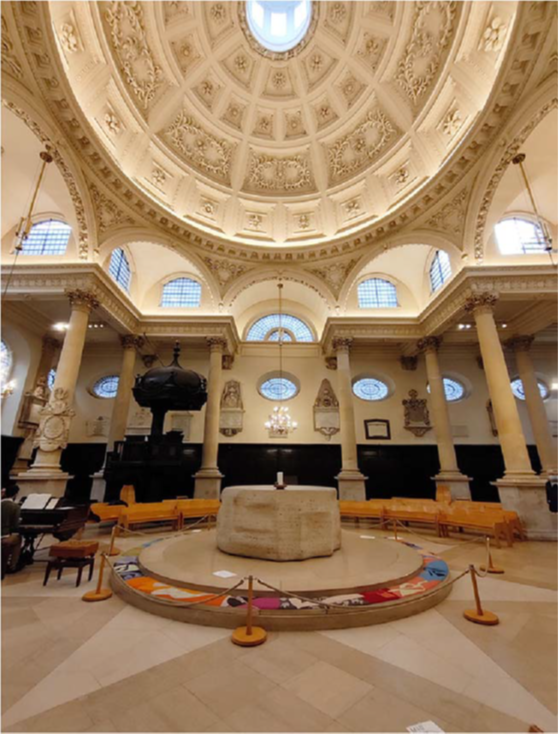
In a recent publication in Acta Acustica, multidisciplinary researchers from the department of architecture of KU Leuven, Belgium investigated these guidelines using ODEON simulations of one of these churches, St Stephen Walbrook. The use of modern-day acoustic methods and metrics such as SPL and STI suggest some of Wren’s design intentions were acoustically effective. The study sheds light on how acoustic problems might have been handled before the advent of today’s methods.
Simulation setup
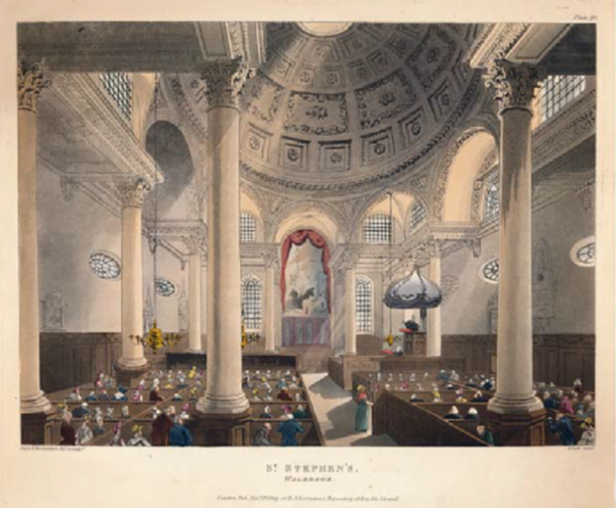
The goal of the simulations was to recreate the St Stephen Walbrook church in its 17th century state. This is a challenge as the church underwent several restorations over the years. The authors used both on-site measurements and historical sources to do so. Two computer models were created, corresponding to the 17th century state and the contemporary state. The main difference resides in the furniture: box pews were used originally, but they are now replaced by wooden benches.
ODEON’s Genetical Material Optimizer was used to fit the current state model to on-site measurements. Interestingly, the measurements presented lower RT than expected at low frequencies, due to sound absorption in air cavities (behind wooden panels) across the church. The authors observed a better fit in terms of T20 than C50, as the latter is more sensitive and may have been more affected by simplifications in the 3D model.
The 17th century model was then created from the current state one by adding box pews, as shown in historical sources.
Once the models were calibrated, different scenarios were investigated, especially in terms of STI and SPL across the church. The following scenarios were simulated in ODEON:
0) 17th century configuration
1) Central pulpit
2) Pulpit from another church (St James Picadilly)
3) Benches instead of pews
4) No dome
5) No sounding board.
Selected results and observations
This section summarises interesting findings from the ODEON simulations. The rest of the results can be found in the full publication.
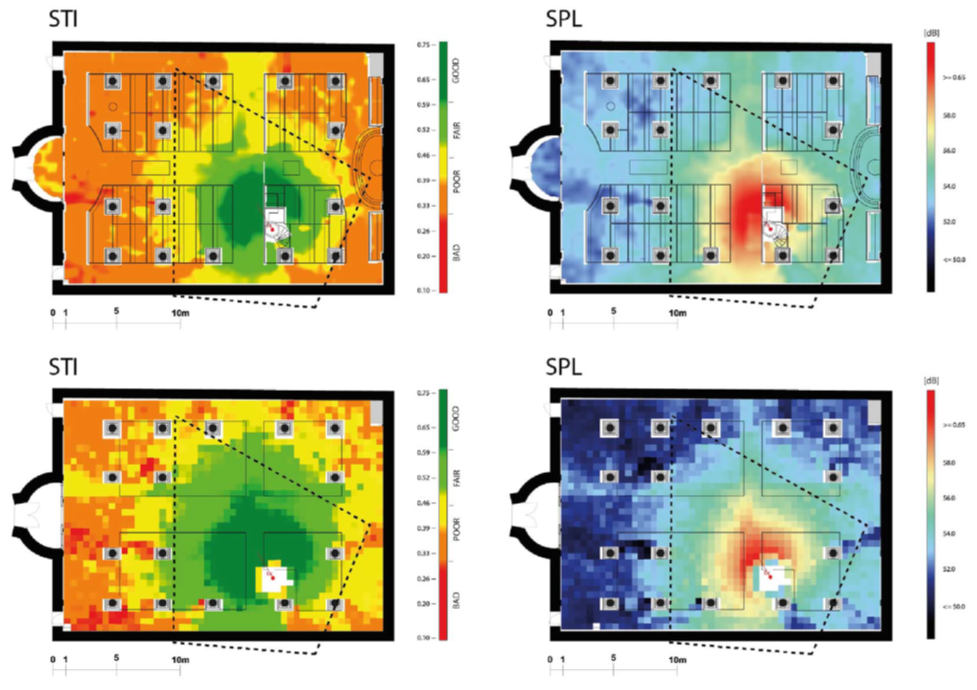
Simulations show that the STI and SPL match quite well with Wren’s recommendations in terms of distance to the speaker. Wren’s recommendations are shown on the paper’s figures as a diamond shape, within which one expects to hear the preacher properly.
Top: simulated STI and SPL in St Stephen Walbrook in the 17th-century configuration with box pews.
Bottom: same when box pews are replaced by benches.
The 17th century box pews have a strong effect on the speech intelligibility, which drop relatively fast with distance to the speaker. Replacing the box pews by benches presents several benefits. The pulpit becomes more visible and accessible to all attendees. Furthermore, benches can accommodate more people, which then leads to more sound absorption at full occupancy. Simulations show that this replacement leads to an improved overall STI, as well as a lower SPL due to the increased sound absorption.
Top: simulated STI and SPL in St Stephen Walbrook in the 17th-century configuration.
Bottom: same with the sounding board removed from the pulpit.
The sounding board on top of the pulpit acts as a reflector for the preacher. This means that early reflections are redirected towards the seats close to the pulpit, thus improving speech intelligibility. It has little effect further away from the source. Moreover, the sounding board reduces the negative effect of the dome above the pulpit, which would otherwise increase reverberation and reduce speech intelligibility.
Auralisations
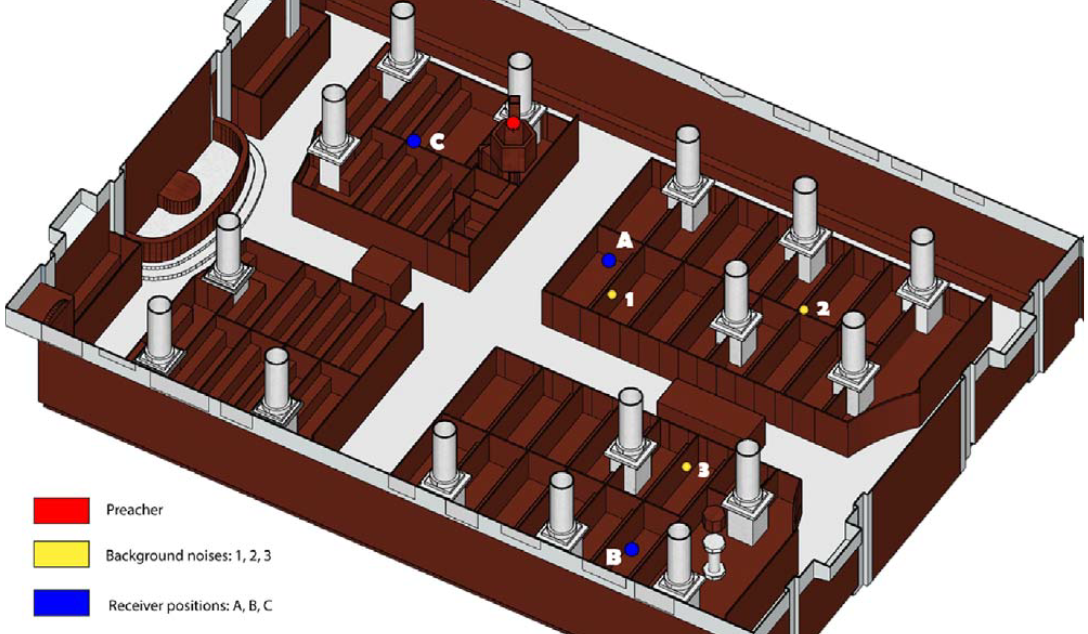
As a complement to acoustic metrics, a sermon speech signal was auralised at different positions in the described scenarios. Purposefully recorded anechoic sermons were used for that purpose. They also illustrate the results discussed earlier in the paper.
Demo sounds
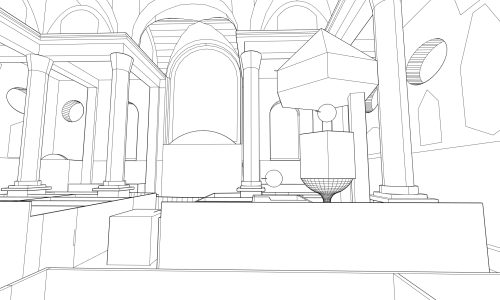
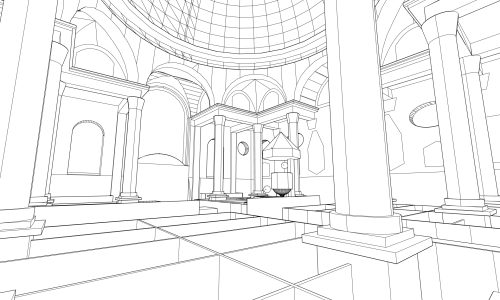
View from receiver
Demo sound
View from receiver
Receiver position A
Demo sound
View from receiver
Receiver position B
Read more
The full paper is available in open access.
Sluyts Y. Houvenaghel M. Morel A-F. Rychtarikova M. & De Jonge K, et al. 2024. An archaeoacoustic analysis of Wren’s auditorium churches: A case study of St Stephen Walbrook (1672–1679), London. Acta Acustica, 8, 70. https://doi.org/10.1051/aacus/2024057.